The Americas
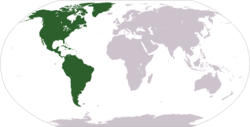
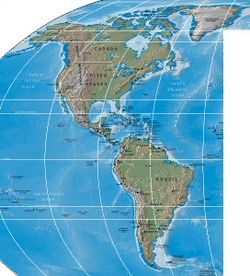
The Americas commonly refers to the landmass in the Western Hemisphere consisting of the continents of North America and South America with their associated islands and regions. more...
The term is a relatively recent and less ambiguous alternative to the term America, which may refer to either the entire landmass or the United States of America. The former, and original, usage is now often considered unusual in English-speaking nations but still in use in other areas, in which the Americas is often described as a single continent or supercontinent, and therefore called America (singular). When used to describe a single landmass, analogous terms to America or (the) Americas are Eurasia, which consists of Europe and Asia collectively, and Eurafrasia, which is Eurasia and Africa.
Naming of America
The earliest known use of the name America for the continents of the Americas dates from 1507. It appears on a globe and a large map created by the German cartographer Martin Waldseemüller in Saint-Dié-des-Vosges. An accompanying book, Cosmographiae Introductio, explains that the name was derived from the Latinized version of the explorer Amerigo Vespucci's name, Americus Vespucius, in its feminine form, America, as the other continents all have Latin feminine names. However, as Dr. Basil Cottle (Author, Dictionary of Surnames, 1967) points out, new countries or continents are never named after a person's first name, always after their second name. Thus, America should really have become Vespucci Land or Vespuccia if the Italian explorer really gave his name to the newly discovered continent. Christopher Columbus, who had first brought the continents' existence to the attention of Renaissance era voyagers, had died in 1506 (believing, to the end, that he'd discovered and conquered part of India) and could not protest Waldseemüller's decision.
Read more at Wikipedia.org