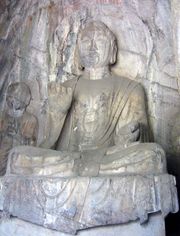
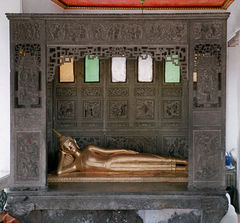
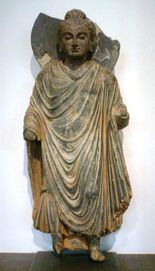
Buddha
Buddha (Pali and Sanskrit) means ‘one who is awake’ (see Bodhi) or ‘one who knows'. more...
A Buddha is a human being who has, through his or her own efforts and wisdom, awoken to the Truth (Dharma) behind appearance, having abandoned and overcome anger, desire and ignorance; attained liberation (moksa) from all suffering (a state of bliss and inner peace called Nirvana or enlightenment), and who possesses far reaching wisdom into the nature of sentient existence. In the sense of ‘one who knows', the word Buddha is closely related to the word buddhi a faculty of mind that may be translated as ‘intuitive discernment.' It is through the operation of this faculty that one is able to awaken and recover one’s own innate Buddhahood.
Common usage
In its most common usage the word Buddha refers to Siddhartha Gautama (c. Sixth Century BCE), a ksatriya prince of the Sakyans (a people of modern-day Northern India and Nepal), who gave up a life of luxury and power to become a wandering mendicant. While walking through the streets of his family's kingdom, he encountered an old person, a sick person, and someone who had died. From this, he realized that suffering pervades all existence and that everything is impermanent. With this motivation, the young prince left the palace to search for something that would give him lasting happiness. At the age of 35, through deep meditation, Siddhartha realized the true nature of mind, thus becoming a Buddha. During the 45 years following his enlightenment, the Buddha gave advice and taught various methods of working with mind and its perfect qualities (fearlessness, joy, and active compassion) to people from all walks of life according to their needs and understanding. These teachings aimed at the development and freedom of body, speech, and mind, and the Buddha is seen as a mirror of this potential in all.
Read more at Wikipedia.org